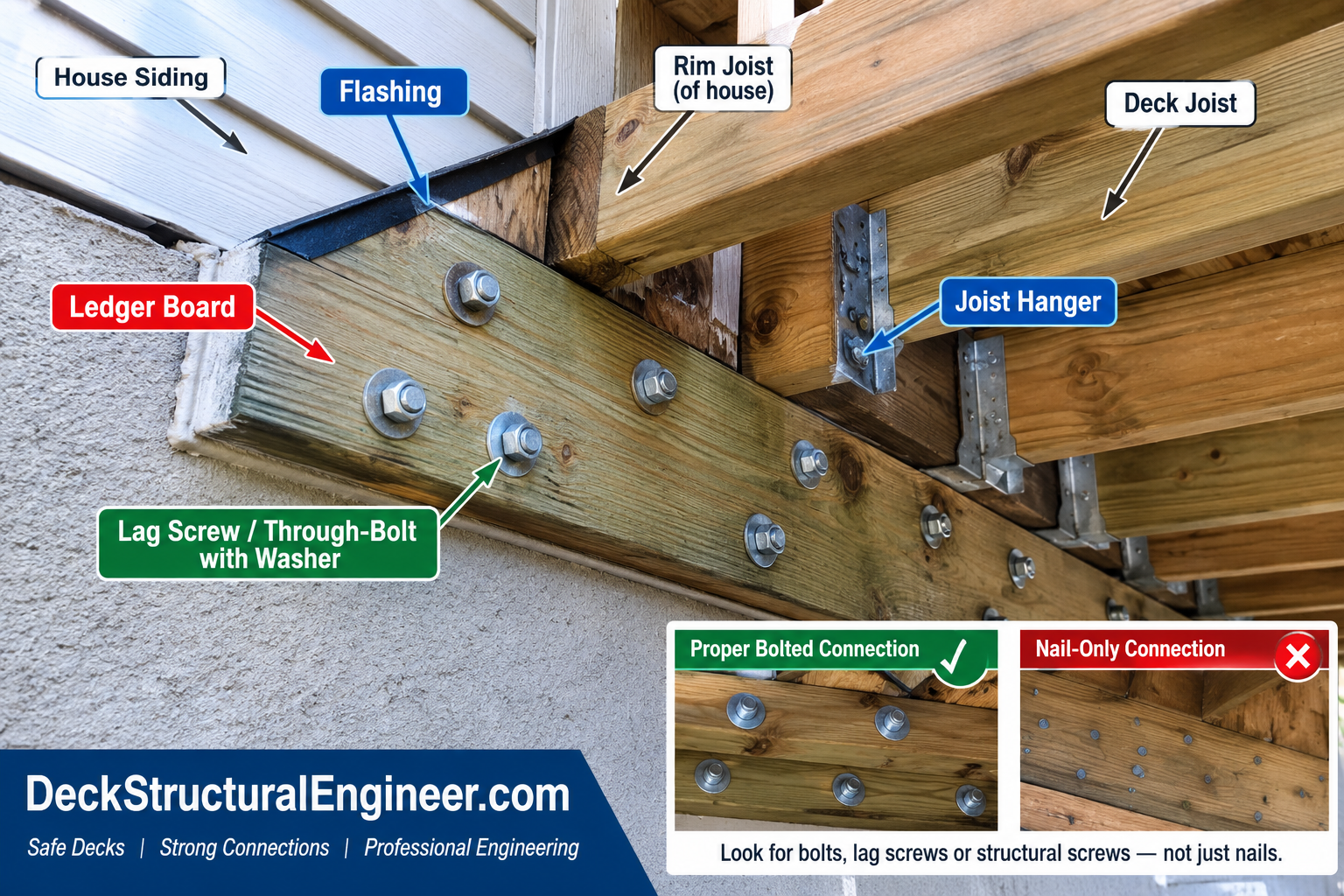
How do you tell whether a deck ledger is properly bolted or simply nailed?
In many cases, you can find out in less than 30 seconds by getting underneath the deck and looking closely at the connection where the deck meets the house.
The ledger board is the horizontal structural member fastened to the house that supports the deck framing. Because the ledger-to-house connection transfers significant deck loads into the building, its fastening and attachment details are among the most important things to inspect on an attached deck.
Look Under the Deck and Check the Fasteners
Stand underneath the deck and examine the ledger where it attaches to the house.
Bolts and structural screws typically have larger heads and are installed in a deliberate, regular pattern. Bolted connections commonly show hex-head bolts with washers, often arranged in staggered rows. Approved structural screws may have distinctive large heads and are also typically installed according to a specified spacing pattern.
Nails, by comparison, generally have much smaller round heads. A ledger that appears to be attached primarily with ordinary nails deserves careful attention, because conventional nails are not an acceptable substitute for the engineered/code-compliant ledger attachment required for many attached deck applications.
However, don't rely on appearance alone. Some structural fasteners can look different from ordinary bolts or nails, and the actual adequacy of a ledger connection depends on factors such as fastener type, diameter, spacing, penetration, wood species, house framing, flashing, and applicable building codes.
Why the Ledger Connection Matters
The ledger connection is a critical part of an attached deck's load path.
Deck occupants, furniture, and other loads are transferred through the deck framing and ledger into the supporting structure of the house. If the ledger connection is improperly designed, installed, deteriorated, or compromised by water intrusion, the consequences can be serious.
A deck can look excellent from above while hiding a potentially inadequate connection.
Fresh stain, attractive decking boards, new railings, and solid-looking stairs do not tell you whether the ledger is properly connected to the house.
Buying or Selling a Home With an Attached Deck?
If you're buying a house with a deck, don't assume that a deck that looks good is structurally sound.
If you're selling a home, identifying potential ledger or connection issues before a home inspection can help you understand what may need attention.
For homeowners, deck builders, contractors, and real estate professionals, a professional structural evaluation can provide considerably more information than a visual inspection from the top of the deck.
Need a Professional Deck Structural Evaluation?
DeckStructuralEngineer.com provides professional deck engineering, structural calculations, CAD drawings, and PE-stamped deck plans for qualifying projects throughout the United States.
Whether you're planning a new deck, modifying an existing deck, preparing for a permit application, or evaluating an older attached deck, understanding the ledger connection is an important part of understanding the deck's overall structural system.
Don't judge a deck by its appearance alone. Look underneath—and verify the structure.